Saturday, April 26, 2014
Friday, April 25, 2014
Aftermath: Population Zero
Aftermath: Population Zero (also titled Aftermath: The World After Humans) is a two-hour Canadian special documentary film that premiered on Sunday, March 9, 2008, on the National Geographic Channel. The program was produced by Cream Productions.
Similar to the History Channel's special Life After People, Aftermath features what scientists and others speculate the earth, animal life, and plant life might be like if humanity no longer existed, as well as the effect that humanity's disappearance would have on the artifacts of civilization. Both documentaries are inspired by Alan Weisman's The World Without Us.
A follow-up 4-part TV series was created, Aftermath, following different scenarios and what happens.
Life after people
Life after people
Life After People is a television series on which scientists, structural engineers, and other experts speculate about what might become of Earth should humanity instantly disappear. The featured experts also talk about the impact of human absence on the environment and the vestiges of civilization thus left behind. The series was preceded by a two-hour special that aired on January 21, 2008 on the History Channel which served as a de facto pilot for the series that premiered April 21, 2009. The documentary and subsequent series were both narrated by James Lurie.
The Future Is Wild
The Future Is Wild (often shortened to F.I.W. was a 2002 thirteen-part documentary television miniseries. Based on research and interviews with several scientists, the miniseries shows how life could evolve in the future if Homo sapiens left the earth. The version broadcast on the Discovery Channel modified this premise, supposing instead that the human race had completely abandoned the Earth and had sent back probes to examine the progress of life on the planet. The show took the form of a nature documentary. It is narrated by John de Lancie in the Discovery Channel version.
Climate Justice
Climate Justice
Charles Lee, 2014 APRIL 24
Climate change is impacting our lives today, including record high temperatures, reduced air quality, extreme weather, severe droughts and sea-level rise, just to name a few examples. While we all share this burden, these impacts greatly exacerbate the many environmental and public health challenges in minority, indigenous and low-income communities. That’s why EPA promotes “climate justice” – a movement, building on more than 20 years of commitment to Environmental Justice, to protect disadvantaged communities disproportionately affected by climate change.
The impacts of climate change on our lives, families and communities are felt by everyone. In low income communities, these impacts are often devastating, including compromised health, financial hardship, and social and cultural disruptions. Often they are the first to experience heat-related illness and death, respiratory ailments, infectious diseases, unaffordable rises in energy costs, and crushing natural disasters.
At the same time, these communities receive less support and experience greater obstacles when trying to influence decisions about mitigating and adapting to climate change impacts. Their voices, concerns and ideas can easily be discounted. We must develop processes that make them active participants in developing solutions.
I know from experience that these communities want their voices heard and valued. They want to participate meaningfully in climate change negotiations and help to develop solutions that will affect their lives and their children’s lives for generations to come. Indeed these communities have much to contribute. For millennia, many indigenous communities have survived through cycles of environmental change using “traditional ecological knowledge” (TEK). This can be immensely useful in developing adaptation and mitigation strategies. For example, TEK may assist in predicting weather patterns, identifying medicinal plants, and adapting new plants to a changing ecosystem.
A 2010 study from the Yale Project on Climate Change and the George Mason University Center for Climate Change Communication found that “in many cases, minorities are equally as supportive, and often more supportive of national climate and energy policies, than white Americans.” In particular:
89% of blacks supported the regulation of carbon dioxide as a pollutant
70% of Asian-Americans consider themselves as environmentalists
60% of Asian-Americans prioritize environmental protection over economic growth
A recent poll shows 74 percent of Latinos believe climate change is a serious or very serious issue, and 86 percent of Latinos support the President taking action to reduce carbon pollution.
As part of EPA’s focus on climate justice, the National Environmental Justice Advisory Council (NEJAC), a federal advisory committee to EPA, is preparing advice and recommendations on how EPA can help improve community resilience in or near industrial waterfronts with environmental justice concerns. This project highlights the efforts of former NEJAC Chair Elizabeth Yiampierre to strengthen community resilience and emergency planning in her overburdened Brooklyn, NY community. NEJAC also embarked recently on a project to provide advice and recommendations for EPA’s individual program and regional climate adaptation implementation plans.
In 2012, communities in California took climate justice to a new level. Their advocacy resulted in legislation that ensures that resources go to communities most hurt by climate change. SB 535 calls for 25 percent of proceeds from the state’s Greenhouse Gas Reduction Fund go to projects that benefit disadvantaged communities. By using CalEnviroScreen to identify disadvantaged communities, the state will make both socio-economic and environmental factors important considerations for determining where potentially billions of dollars of climate change resources will go.
It’s evident that minority, indigenous and low-income communities not only care about the impacts of climate change, but have been leaders in creating solutions. They believe strongly that as a nation, we can address climate change with common-sense, comprehensive strategies. In that process, they will help us build healthier and more sustainable communities, as well as a stronger more inclusive economy beneficial to all citizens.
A Nonviolent Insurgency for Climate Protection
Where the old institutions have failed, insurgent global citizens must now defend the climate directly and preserve the public trust for generations to come.
Jeremy Brecher, December 10, 2013
Where the old institutions have failed, insurgent global citizens must now defend the climate directly and preserve the public trust for generations to come.
Jeremy Brecher, December 10, 2013
When 30 climate activists from 18 countries protested drilling at an oil platform operated by Gazprom in the Russian Arctic, they represented the people of the world taking a symbolic stand against climate destruction, the corporate climate destroyers, and the governments that back them. But the action of the Arctic 30 may be prophetic of something more: The emergence of a global insurgency that challenges the very legitimacy of those who are destroying our planet.
The 2013 Fifth Report of the Intergovernmental Panel on Climate Change confirmed that humans are destroying the earth’s climate. But it also revealed something even more alarming: Twenty-five years of human effort to protect the climate have failed even to slow the forces that are destroying it. On the contrary, the rate of increase in carbon emissions from burning fossil fuels tripled between the release of the first IPCC report in 1988 and today.
Scientists and climate protection advocates once expected that rational leaders and institutions would respond appropriately to the common threat of climate change. As Bill McKibben said of Jim Hansen and himself, “I think he thought, as did I, if we get this set of facts out in front of everybody, they’re so powerful — overwhelming — that people will do what needs to be done.”
It didn’t work. Those who are fighting to save the climate need a new strategy. One such strategy to consider is a global nonviolent law-enforcing insurgency, where citizens take it upon themselves to defend the climate directly and preserve the public trust for generations to come.
Read the report (PDF).
The 2013 Fifth Report of the Intergovernmental Panel on Climate Change confirmed that humans are destroying the earth’s climate. But it also revealed something even more alarming: Twenty-five years of human effort to protect the climate have failed even to slow the forces that are destroying it. On the contrary, the rate of increase in carbon emissions from burning fossil fuels tripled between the release of the first IPCC report in 1988 and today.
Scientists and climate protection advocates once expected that rational leaders and institutions would respond appropriately to the common threat of climate change. As Bill McKibben said of Jim Hansen and himself, “I think he thought, as did I, if we get this set of facts out in front of everybody, they’re so powerful — overwhelming — that people will do what needs to be done.”
It didn’t work. Those who are fighting to save the climate need a new strategy. One such strategy to consider is a global nonviolent law-enforcing insurgency, where citizens take it upon themselves to defend the climate directly and preserve the public trust for generations to come.
Read the report (PDF).
How Guy McPherson gets it wrong
SCOTT K. JOHNSON, 02/17/2014 fractalplanet.wordpress.com
Recently, a few Ars Technica commenters have been posting references to the work of Guy McPherson on climate articles. McPherson is a retired professor of ecology at the University of Arizona, and he runs a blog called Nature Bats Last. In recent years, he has turned his energies to dire warnings of impending climate catastrophe. Those warnings go far beyond what you’ll find anywhere else: McPherson believes humans will go extinct in as little as two decades.
Now, lots of people run blogs that make wild claims, so why am I spending time on this one? McPherson claims to simply be passing along scientific data to the public— data that most scientists are unwilling to talk about and governments are trying to keep secret. As a result, his followers (I mean to use that term more in the Twitter sense than a religious one) seem confident that they have the weight of science behind them. It takes careful examination of McPherson’s references, and a familiarity with the present state of climate science, to uncover that his claims aren’t scientific at all. I also get the feeling that his internet following might not be insignificant (as noted by climate scientist Michael Tobis) and could be growing, yet I couldn’t find any direct challenges with a web search. This makes one.
Bizarro denial
First, I want to go over general problems with McPherson’s claims and talk about what climate science is really telling us. For those wanting specifics, I’ll post a list of point-by-point corrections of McPherson’s main “Climate Change Summary and Update” post in the third section.
In many ways, McPherson is a photo-negative of the self-proclaimed “climate skeptics” who reject the conclusions of climate science. He may be advocating the opposite conclusion, but he argues his case in the same way. The skeptics often quote snippets of science that, on full examination, doesn’t actually support their claims, and this is McPherson’s modus operandi. The skeptics dismiss science they don’t like by saying that climate researchers lie to keep the grant money coming; McPherson dismisses inconvenient science by claiming that scientists are downplaying risks because they’re too cowardly to speak the truth and flout our corporate overlords. Both malign the IPCC as “political” and therefore not objective. And both will cite nearly any claim that supports their views, regardless of source— putting evidence-free opinions on par with scientific research. (In one example I can’t help but highlight, McPherson cites a survivalist blog warning that Earth’s atmosphere is running out of oxygen.)
McPherson bills himself as a scientist simply passing along the science (even as he dismisses climate scientists and their work), but he cites nearly as many blog posts and newspaper columns as published studies. When he does cite a study, it’s often clear that he hasn’t taken the time to actually read it, depending instead on a news story about it. He frequently gets the information from the study completely wrong, which is a difficult thing for most readers to check given that most papers are behind paywalls (not to mention that scientific papers aren’t easy to understand).
McPherson leans heavily on claims from people associated with the “Arctic News” blog about a catastrophic, runaway release of methane that supposedly is already underway in the Arctic. Unfortunately (or, rather, fortunately), the data don’t match their assertions. The latest IPCC and NAS assessment reports, in fact, deemed such a release “very unlikely” this century. One reason for that is that the Arctic has been this warm or warmer a couple times in the last 200,000 years, yet that methane stayed in the ground. Another reason is that scientists actually bother to study and model the processes involved. One thing McPherson and others like to point to is the recent work by Natalia Shakhova’s group observing bubbling plumes of methane coming up from the seafloor on the Siberian Shelf. Since we’ve only been sampling these plumes for a few years, we have no idea whether that release of methane is increasing or if these are long-term features. Similar plumes off Svalbard, for example, appear to be thousands of years old. (More to put this methane in context here.)
That’s exactly the kind of detail and nuance that’s absent from McPherson’s claims. Instead, he’s content to link to YouTube videos or blog posts (some ludicrously unscientific— see below) and run with the idea that catastrophic warming is guaranteed as a result. He just latches onto anything that sounds scary. McPherson is especially fast and loose with timeframes. He likes to point to the magnitude of past climate changes (which took thousands of years or more) as proof that we are about to undergo similar changes in the next couple decades. That’s quite clearly a fallacious argument, but McPherson never concerns himself with the details. All the casual reader learns it that there was a huge change in the past analogous to the present that shows just how screwed we really are.
And that’s McPherson’s thing— despair. We’re absolutely doomed, he tells us, and there’s nothing we can do about it. Everything is lost. He derides any sort of optimism or action as “hopium”. He notes in one recent post that “With an eye to improving my ‘bedside manner’ when I deliver presentations, I’ve recently become a certified grief-recovery counselor.” With such an extraordinary view, you would expect him to make the scientific case for extinction very clearly. But he does not. His argument fundamentally reduces to “positive feedbacks exist, ergo extinction”. That is, he lists examples of positive feedbacks (things that amplify change, like the added sunlight absorption of ocean water that has lost its sea ice cover) for a while, intending to overwhelm you with the number of processes that could add to global warming. And that’s it. There are no numbers explaining how big an effect each could have, no analysis of likely warming impacts, nothing. The fact is that climate scientists know about all these processes. But instead of throwing their hands up and saying “Oh, shit”, they actually do science.
Again, specific examples of these things are given in the last section of this post. If you take a look at some of his mistakes and demonstrably false claims, you’ll have a hard time thinking of him as a credible source of information.
[Update 3-13-14: Michael Tobis has covered some of the points I skipped over—namely, McPherson's discussion of feedbacks— in a new post.]
This is just an excerpt of SJ's article. Read more here
Labels:
abrupt climate change,
analysis,
crisis,
feedback loop,
Guy McPherson,
scientist,
timeline
What Scientists Are Seeing Over Antarctica
Published on Dec 1, 2012
NASA's Operation IceBridge has launched its Antarctic 2012 campaign, flying high-priority missions measuring polar ice from a base of operations at the tip of Patagonia on the Strait of Magellan. They have even made a return visit to the Pine Island Glacier, the site of last year's discovery of a massive rift in the ice.
Sea ice doesn't always hold the allure of a massive ice sheet, or a crevassed blue glacier spilling between mountains, but it comes in array of shapes and sizes and has its own ephemeral beauty. Operation IceBridge studies sea ice at both poles, and also runs across interesting formations on route to other targets. Operation IceBridge returned to the Pine Island Glacier twice in 2012, and NASA glaciologist Kelly Brunt discusses the implications of the glacier's impending calving event.
Operation IceBridge has now returned to the Pine Island Glacier, not once, but twice in 2012. And the year-old giant crack in the glacier, poised to create an iceberg the size of New York City? Well it's still there, and that iceberg has yet to break free. But the rift has grown longer, much wider, and spawned a secondary crack. Before we talk about when that mighty berg will be born, let's take a look at the IceBridge missions themselves. IceBridge's first return to the region was a high altitude flight over the entire region, including the Thwaites, Smith, and Kohler glaciers. After this campaign is over, scientists will be able to compare this broad survey with previous years' measurements in order to better document the rapid and widespread changes in the region over time.
Thursday, April 24, 2014
NASA | Earth from Orbit 2013
Published on Apr 21, 2014
A fleet of orbiting satellites monitors Earth constantly. The satellites from NASA and other space agencies give us a fresh, wide perspective on things that we can see from the ground -- and things that we can't.
A look back at Earth in 2013 from the viewpoint of orbit reveals the kind of data gathering and technical achievement that are the reason NASA puts Earth-observing satellites in space. A visualization of satellite and computer model data shows how a cloud of dust from the Chelyabinsk meteor moved around the world. NASA satellites measured the intensity of wildfires, the salinity of the oceans and rainfall around the globe -- whether it was too little or too much.
To learn more about NASA's Earth science in 2014, please visit: www.nasa.gov/earthrightnow
Two degrees
Two degrees
How the world failed on climate change
Brad Plumer, April 22, 2014 vox.com
It was the early 1990s. Climate scientists had long known that humans were warming up the planet. But politicians were just beginning to grasp that it would take a huge coordinated effort to get nations to burn fewer fossil fuels and avoid sharp temperature increases in the decades ahead.
Those policymakers needed a common goal — a way to say, Here’s how bad things will get and This is what we need to do to stop it. And that posed a dilemma. No one could really agree on how much global warming was unacceptable. How high did the seas need to rise before we had a serious problem? How much heat was too much?
Around this time, an advisory council of scientists in Germany proposed a stunningly simple way to think about climate change. Look, they reasoned, human civilization hasn’t been around all that long. And for the last 13,000 years, Earth’s climate has fluctuated within a narrow band. So, to be on the safe side, we should prevent global average temperatures from rising more than 2° Celsius (or 3.6° Fahrenheit) above what they were just before the dawn of industrialization.
Critics grumbled that the 2°C limit seemed arbitrary or overly simplistic. But scientists were already compiling evidence that the risks of global warming became especially daunting somewhere above the 2°C threshold: rapid sea-level rise, the risk of crop failure, the collapse of coral reefs. And policymakers loved the idea of a simple, easily digestible target. So it stuck.
The idea that the world can stay below 2°C looks increasingly delusional
By 2009, nearly every government in the world had endorsed the 2°C limit— global warming beyond that level was deemed "dangerous." And so, every year, the world’s leaders meet at UN climate conferences to discuss policies and emissions cuts that they hope will keep us below 2°C. Climate experts churn out endless papers on how we can adapt to 2°C of warming (or less).
Two decades later, there’s just one major problem with this picture. The idea that the world can stay below 2°C looks increasingly delusional.
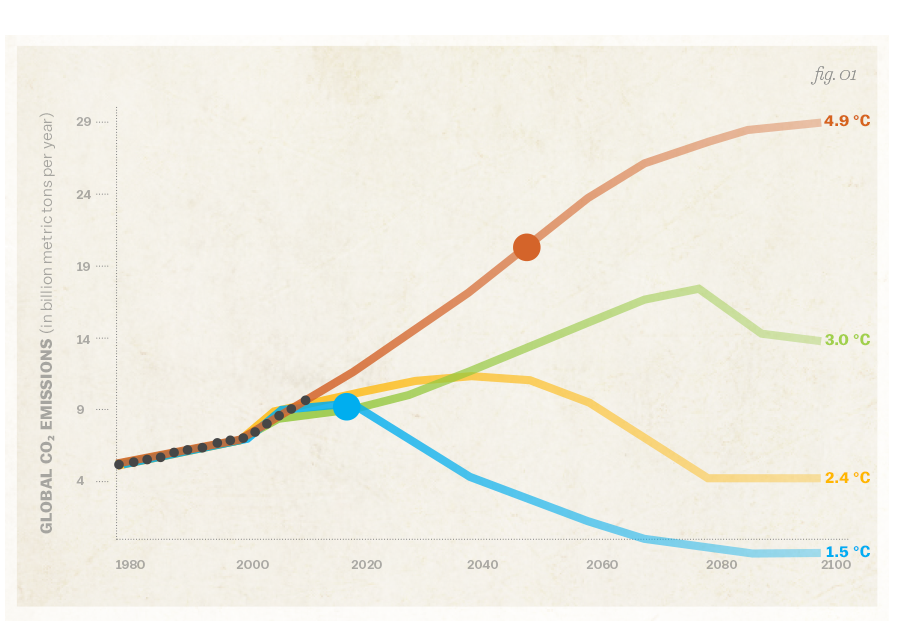
Consider: the Earth’s average temperature has already risen 0.8°C since the 19th century. And if you look at the current rapid rise in global greenhouse-gas emissions, we’re on pace to blow past the 2°C limit by mid-century — and hit 4°C or more by the end. That’s well above anything once deemed "dangerous."Getting back on track for 2°C would, at this point, entail the sort of drastic emissions cuts usually associated with economic calamities, like the collapse of the Soviet Union or the 2008 financial crisis. And we’d have to repeat those cuts for decades.
The climate community has been slow to concede defeat. Back in 2007, the UN's Intergovernmental Panel on Climate Change published a report noting that the world could stay below 2°C — but only if we started cutting emissions immediately. The years passed, countries did little, and emissions kept rising. So, just this month, the IPCC put out a new report saying, OK, not great, but we can still stay under 2°C. We just need to act more drastically and figure out some way to pull carbon dioxide back out of the atmosphere. (Never mind that we still don’t have the technology to do the latter.)
We're on track for 4°C of global warming — and 2°C is increasingly unlikely
Predicted temperature increases under various emissions scenarios:

On our current course, the world will put enough carbon-dioxide in the atmosphere by mid-century to breach the 2°C target.
Emissions would need to decline dramatically (and then go negative) for a good shot at staying below 2°C.
"At some point, scientists will have to declare that it’s game over for the 2°C target," says Oliver Geden, a climate policy analyst at the German Institute for International and Security Affairs. "But they haven’t yet. Because nobody knows what will happen if they call this thing off." The 2°C target was one of the few things that everyone at global climate talks could agree on. If the goal turns out to be impossible, people might just stop trying altogether.
Recently, then, some scientists and policymakers have been taking a fresh look at whether the 2°C limit is still the best way to think about climate change. Is this simple goal actually making it harder to prepare for the warming that lies ahead? Is it time to consider other approaches to climate policy? And if 2°C really is so dangerous, what do we do when it’s out of reach?
The murky origins of the 2°C limit
Back in the 1970s, climate scientists understood that the carbon dioxide that humans had been emitting since the Industrial Revolution — from cars, power plants, factories — was intensifying the greenhouse effect that warms the planet. They also knew that man-made emissions were increasing each year as the global economy grew.
So how hot would it get? Early calculations suggested that if we doubled the amount of carbon dioxide in the atmosphere over pre-industrial levels, the Earth would warm somewhere between 1.5°C and 4.5°C. In the decades since, scientists have amassed more evidence for this estimate of "climate sensitivity," but they haven't really narrowed the range.
The next step was to figure out how much warming humans could safely tolerate. There were a variety of ideas for defining "dangerous" interference with the Earth’s climate in the early 1990s. Maybe we should try to limit the rate of warming per decade, for instance.
Eventually, the 2°C limit won out — endorsed by, among others, a council of German scientists advising Angela Merkel, the nation’s environment minister at the time. Their thinking: human civilization had developed in a period when sea levels remained stable and agriculture could flourish. Staying within that bound — and preventing global average temperatures from rising more than 2°C — seemed like a reasonable rule of thumb.
"We said that, at the very least, it would be better not to depart from the conditions under which our species developed"
"We said that, at the very least, it would be better not to depart from the conditions under which our species developed," recalls Hans Joachim Schellnhuber, one of the scientists on that German advisory panel who helped devise the 2°C limit. "Otherwise we’d be pushing the whole climate system outside the range we’ve adapted to."
Over time, researchers gravitated toward this limit. An influential 2001report from the UN’s Intergovernmental Panel on Climate Change detailed a number of reasons to worry about climate change: increased heat waves and storms, the threat of mass extinctions, severe economic losses. Many of these so-called "reasons of concern" were projected to get much worse as global warming climbed past 2°C.
Now, there are good arguments that the 2°C limit is arbitrary. Any limit would be. For instance, subsequent research has found that plenty of worrisome impacts actually happen well before we hit 2°C: Arctic sea ice could collapse, coral reefs could die off, tiny island nations like Tuvalu could get swallowed by the rising seas. Conversely, other worrisome changes, such as crop damage in the United States, might not happen until we go above the 2°C threshold. Deciding where to draw this line is a political judgment as much as a scientific one. (To put it another way, no climate scientist thinks we'll be totally fine if we hit 1.9°C of warming but totally doomed if we hit 2.1°C.)
Economists, meanwhile, have often criticized the 2°C limit for not taking costs into account. After all, we don’t just burn oil, gas, and coal for fun. We use them to power our cars and homes and factories. And cutting back won't be painless. William Nordhaus, an economist at Yale, has argued that we should aim for a temperature limit where the costs of reducing fossil fuels matches the climate benefits. In his book The Climate Casino, he pegs this limit at 2.5°C or possibly higher, depending on how easily we can switch to clean energy sources.
Still, despite the criticisms, the 2°C limit has maintained its dominant position for more than a decade — in part because it created an easy focal point for international negotiations. UN climate talks start by assuming the need to stay below 2°C and then work backward to hash out how each country should cut emissions. The European Union’s energy policies consistently reference this limit. The Obama administration’s upcoming rules to restrict carbon-dioxide emissions from US coal plants can be traced back to a pledge President Obama made in 2009 to help stay below 2°C.
That raises a question: what will happen if it becomes apparent that the 2°C limit is out of reach? Will we settle on a new limit? Or just give up altogether?
Why the 2°C limit looks increasingly impossible
Here’s how climate experts often think about the 2°C limit. Estimates of climate sensitivity tell us that the Earth will eventually warm somewhere between 1.5°C and 4.5°C if we double the amount of carbon dioxide in the atmosphere over pre-industrial levels. And we’re almost halfway to doubling.
So, if we want reasonable odds of staying below 2°C, there’s only so much more additional carbon dioxide we can put in the atmosphere. That’s our "carbon budget" — around 485 billion metric tons.
There’s not a lot of wiggle room left. Humans added the equivalent of 10 billion metric tons of carbon into the atmosphere in 2012, and that amount is rising every year, as fast-growing countries like China and India build new factories, drive new cars, and burn lots of fossil fuels. At current rates, the world will exhaust its carbon budget in roughly three decades, setting the stage for 2°C of warming. (If climate sensitivity turns out to be low, that only buys us an extra decade or so.)
If we want to stay within the budget and avoid 2°C, then, our annual emissions need to start declining each year. Older, dirtier coal plants would need to get replaced with cleaner wind or solar or nuclear plants, say. Or gas-guzzling SUVs would need to get replaced with new low-carbon electric cars. But the longer we put this off, the harder it gets — the carbon budget gets smaller, and there are more coal plants and SUVs to replace.
The longer we wait on cutting emissions, the harder it gets
If we want a reasonable shot at staying below 2°C, there’s only so much more carbon-dioxide we can load into the atmosphere. If the world had started back in 2005, emissions could have decreased gently each year. If we wait until, say, 2020, the cuts have to be much sharper to catch up.
By now, countries have delayed action for so long that the necessary emissions cuts will have to be extremely sharp. In April 2014, the UN's Intergovernmental Panel on Climate Change (IPCC) concluded that if we want to stay below the 2°C limit, global greenhouse-gas emissions would have to decline between 1.3 percent and 3.1 percent each year, on average, between 2010 and 2050.
"If you’re serious about 2°C, the rates of change are so significant, it begs the way we see the world"
To put that in perspective, global emissions declined by just 1 percent for a single year after the 2008 financial crisis, during a brutal recession when factories and buildings around the world were idling. We'd potentially have to triple that pace of cuts, and sustain it year after year.
Some climate experts are skeptical that countries can do this while maintaining their historical rates of economic growth. The fastest that any country has ever managed to decarbonize its economy without suffering a crushing recession was France, when it spent billions to scale up its nuclear program between 1980 and 1985. That was a gargantuan feat — emissions fell 4.8 percent per year — but the country only sustained it for a five-year stretch.
To stay within the 2°C budget, every country would have to keep up that pace for decades, decarbonizing not just power plants, but factories, and homes, and cars, and airplanes. That goes far beyond even the most ambitious climate proposals currently being considered, including Obama's big plan to curb emissions from US coal plants.
"If you’re serious about 2°C, the rates of change are so significant that it begs the way we see the world. That’s what people aren’t prepared to embrace," says Kevin Anderson, a climate scientist at the Tyndall Centre for Climate Research. "Essentially you’d have to start asking questions about our current society and how we develop and grow."
Anderson, for one, has argued that wealthy countries may need to sacrifice economic growth, at least temporarily, to stay below 2°C. In December, the Tyndall Centre hosted a conference on "radical emissions reductions" that offered some eye-popping suggestions: Perhaps every adult in wealthy countries could get a personal "carbon budget" tracked through an electronic credit card. Once they hit their limit, no more vacations or road trips. Other attendees suggested shaming campaigns against celebrities with outsized homes and yachts.
Not everyone is ready to go radical. The IPCC’s latest report suggested that an ambitious push on clean energy might only put a modest dent in global economic growth rates (a mere 0.06 percentage points per year). That's partly because the cost of solar and wind power has been dropping far faster than anyone expected.
But even when you account for that, the IPCC figured that staying below 2°C would depend on a series of long-shot maneuvers: all nations would need to act right this second, ramp up wind and solar and nuclear power massively, and figure out still-nascent technologies to capture and bury emissions from coal plants. Crucially, we'd also have to invent some method of pulling carbon dioxide out of the atmosphere — something that may never work on a large scale.
If any of those assumptions falter, the IPCC noted, costs start rising. And, as the years go by and the world’s nations put off cutting emissions, the odds of staying below 2°C look vanishingly unlikely.
"Ten years ago, it was possible to model a path to 2°C without all these heroic assumptions," says Peter Frumhoff of the Union of Concerned Scientists. "But because we've dallied for so long, that's no longer true." In February, Frumhoff co-authored a paper in Nature Climate Change arguing that policymakers need to take the prospect of breaching the 2°C limit far more seriously than they're currently doing. Otherwise, we'll find ourselves unprepared for what comes next.

What’s so bad about 3°C or 4°C?
If 2°C looks increasingly out of reach, then it’s worth looking at what happens if we blow past that and go to, say, 3°C or 4°C.
Four degrees (or 7.2° Fahrenheit) may not sound like much. But the world was only about 4°C to 7°C cooler, on average, during the last ice age, when large parts of Europe and the United States were covered by glaciers. The IPCC concluded that changing the world’s temperature in the opposite direction could bring similarly drastic changes, such as "substantial species extinctions," or irreversibly destabilizing Greenland's massive ice sheet.
In 2013, researchers with the World Bank took a look at the science on projected effects of 4°C warming and were appalled by what they found. A growing number of studies suggest that global food production could take a big hit under 3°C or 4°C of warming. Poorer countries like Bangladesh, Egypt, Vietnam, and parts of Africa could see large tracts of farmland made unusable by rising seas.
But what seemed to unnerve the authors of the World Bank report most was all of the stuff we don’t know. Most climate models currently make predictions in a linear fashion. That is, they basically assume that the impacts of 4°C of warming will be twice as bad as those of 2°C. But that might be wrong. Impacts may interact with each other in unpredictable ways. Current agriculture models, they noted, don’t have a good sense for what will happen to crops if heat waves, droughts, new pests and diseases all combine together.
"If we keep assuming we can stay below 2°C as a matter of course, then we aren’t being honest about the adaptation challenges"
Here’s an analogy that Hans Joachim Schellnhuber, who helped compile some of the research for the World Bank, likes to use. "Take the human body. If your temperature rises 2°C, you have a significant fever. If it rises 4°C or 6°C you can die. It’s not a linear change. You’re pushing a complex system outside the range it’s adapted to. And all our assessments indicate that once you do that, the system’s resilience gets stretched thin."
Perhaps most significantly, the World Bank report wasn’t even sure if humanity could adapt to a 4°C world. At the moment, the large lender is helping poorer countries prepare for global warming by building seawalls, conducting crop research, and improving freshwater management. But, as an internal review found, most of these efforts are being done with relatively small temperature increases in mind. The bank wasn’t planning for 3°C or 4°C of global warming — because no one really knew what that might entail.
"[G]iven that uncertainty remains about the full nature and scale of impacts," the report said, "there is also no certainty that adaptation to a 4°C world is possible." And its conclusion was stark: "The projected 4°C warming simply must not be allowed to occur."
Only very recently have scientists even started trying to fill in those gaps in knowledge. Here’s a telling anecdote: back in 2011, the European Commission put out a call for papers exploring the impacts of a 2°C rise in temperature. Two years later, the call went out for impacts of warming greater than 2°C. What was once unthinkable is quickly becoming thinkable.
"If we keep assuming we can stay below 2°C as a matter of course, then we aren’t being honest about the adaptation challenges," says Frumhoff of the Union of Concerned Scientists. For example, he notes, California might need to completely overhaul its water-planning efforts for the coming century if 3°C or 4°C becomes a serious possibility.
But so far, these sorts of planning efforts are scant — because few policymakers are prepared to admit that we're going beyond 2°C.
The frantic search for alternatives to 2°C
The impossibility of staying below 2°C could also shake up the politics of climate change. After all, the UN climate talks are structured around this overarching goal. What will happen if everyone realizes it’s unreachable?
Last year, Geden, the German Institute researcher, broached this topic in a paper titled "Modifying the 2°C Target." Then, in October, 11 researchers at the Tyndall Centre published a paper in Climate Policyexploring further alternatives to the 2°C limit. Here are a few options on offer:
Geoengineering: We could try to stay below 2°C through last-ditch "geoengineering" efforts. Some scientists have pointed out that we could, in theory, cool the Earth by putting sulfate particles into the atmosphere that reflect the sun. The downside? This could have all sorts of gruesome side effects, such as messing up global rainfall patterns. And it wouldn't alleviate other dire impacts of our carbon-dioxide emissions, such as ocean acidification.
Accept (slightly) higher temperatures: Alternatively, policymakers could concede that 2°C is unworkable and instead work to stay below a slightly higher limit like 2.5°C or 3°C. This sounds easy: we simply accept that we’re going to face higher climate risks and try to adapt. And even if 3°C of warming is riskier than 2°C, it's less risky than 4°C.
But there’s a hitch. As Geden points out, relaxing the limit might make global climate talks even less productive than they already are. The temperature limits themselves would suddenly be open to negotiation and endless squabbling. The Tyndall researchers worried that this could allow the world to drift into a situation where 4°C or 6°C is accepted as inevitable.
Abandoning the 2°C limit might make international climate talks even less productive
Reframe the problem: Alternatively, the world could rephrase its goals in more appealing terms. Some experts have argued that 2°C was never a particularly useful limit because it was so difficult to translate into action. The University of Colorado’s Roger Pielke Jr. has suggested that we could focus on easier-to-grasp goals like increasing the proportion of carbon-free energy that the world uses — say, going from 13 percent today to 90 percent. That would achieve similar ends, but it’s a vastly different way of framing the problem.
"It puts you in a different intellectual space, where your answers are focused on the deployment of vast amounts of clean energy," Pielke told me earlier this year. "It’s a politics of possibility and opportunity where innovation is at the center. We may end up no better off than we are now. But the path we’re on now is going nowhere."
Similarly, David Victor of the University of California, San Diego has long argued that starting with an agreed-upon temperature limit and then brow-beating countries into adopt the required cuts is doomed to failure. Instead, it might be more productive for countries to focus on taking individual steps on climate and slowly building up toward an agreed-upon target.
In their Climate Policy paper exploring these alternatives, the Tyndall Centre researchers noted that all of the approaches carry drawbacks — reframing the problem, for instance, could divert attention away from the dangers of higher temperatures. Ultimately, they couldn’t let go of the idea that recommitting to the 2°C limit might just be the "least unattractive course of action." But, they noted, the world would have to take the problem much, much more seriously than it's currently doing.
Whatever the right answer here is, the authors wrote, it’s at least something that needs to be discussed more fully. "There’s a real danger that the 2°C goal will become discredited," says the Tyndall Centre’s Tim Rayner, one of the co-authors of the paper. "We think it’s important to begin the debate before that eventuality hits."
How the world failed on climate change
Brad Plumer, April 22, 2014 vox.com
It was the early 1990s. Climate scientists had long known that humans were warming up the planet. But politicians were just beginning to grasp that it would take a huge coordinated effort to get nations to burn fewer fossil fuels and avoid sharp temperature increases in the decades ahead.
Those policymakers needed a common goal — a way to say, Here’s how bad things will get and This is what we need to do to stop it. And that posed a dilemma. No one could really agree on how much global warming was unacceptable. How high did the seas need to rise before we had a serious problem? How much heat was too much?
Around this time, an advisory council of scientists in Germany proposed a stunningly simple way to think about climate change. Look, they reasoned, human civilization hasn’t been around all that long. And for the last 13,000 years, Earth’s climate has fluctuated within a narrow band. So, to be on the safe side, we should prevent global average temperatures from rising more than 2° Celsius (or 3.6° Fahrenheit) above what they were just before the dawn of industrialization.
Critics grumbled that the 2°C limit seemed arbitrary or overly simplistic. But scientists were already compiling evidence that the risks of global warming became especially daunting somewhere above the 2°C threshold: rapid sea-level rise, the risk of crop failure, the collapse of coral reefs. And policymakers loved the idea of a simple, easily digestible target. So it stuck.
The idea that the world can stay below 2°C looks increasingly delusional
By 2009, nearly every government in the world had endorsed the 2°C limit— global warming beyond that level was deemed "dangerous." And so, every year, the world’s leaders meet at UN climate conferences to discuss policies and emissions cuts that they hope will keep us below 2°C. Climate experts churn out endless papers on how we can adapt to 2°C of warming (or less).
Two decades later, there’s just one major problem with this picture. The idea that the world can stay below 2°C looks increasingly delusional.
Consider: the Earth’s average temperature has already risen 0.8°C since the 19th century. And if you look at the current rapid rise in global greenhouse-gas emissions, we’re on pace to blow past the 2°C limit by mid-century — and hit 4°C or more by the end. That’s well above anything once deemed "dangerous."Getting back on track for 2°C would, at this point, entail the sort of drastic emissions cuts usually associated with economic calamities, like the collapse of the Soviet Union or the 2008 financial crisis. And we’d have to repeat those cuts for decades.
The climate community has been slow to concede defeat. Back in 2007, the UN's Intergovernmental Panel on Climate Change published a report noting that the world could stay below 2°C — but only if we started cutting emissions immediately. The years passed, countries did little, and emissions kept rising. So, just this month, the IPCC put out a new report saying, OK, not great, but we can still stay under 2°C. We just need to act more drastically and figure out some way to pull carbon dioxide back out of the atmosphere. (Never mind that we still don’t have the technology to do the latter.)
We're on track for 4°C of global warming — and 2°C is increasingly unlikely
Predicted temperature increases under various emissions scenarios:
On our current course, the world will put enough carbon-dioxide in the atmosphere by mid-century to breach the 2°C target.
Emissions would need to decline dramatically (and then go negative) for a good shot at staying below 2°C.
"At some point, scientists will have to declare that it’s game over for the 2°C target," says Oliver Geden, a climate policy analyst at the German Institute for International and Security Affairs. "But they haven’t yet. Because nobody knows what will happen if they call this thing off." The 2°C target was one of the few things that everyone at global climate talks could agree on. If the goal turns out to be impossible, people might just stop trying altogether.
Recently, then, some scientists and policymakers have been taking a fresh look at whether the 2°C limit is still the best way to think about climate change. Is this simple goal actually making it harder to prepare for the warming that lies ahead? Is it time to consider other approaches to climate policy? And if 2°C really is so dangerous, what do we do when it’s out of reach?
The murky origins of the 2°C limit
Back in the 1970s, climate scientists understood that the carbon dioxide that humans had been emitting since the Industrial Revolution — from cars, power plants, factories — was intensifying the greenhouse effect that warms the planet. They also knew that man-made emissions were increasing each year as the global economy grew.
So how hot would it get? Early calculations suggested that if we doubled the amount of carbon dioxide in the atmosphere over pre-industrial levels, the Earth would warm somewhere between 1.5°C and 4.5°C. In the decades since, scientists have amassed more evidence for this estimate of "climate sensitivity," but they haven't really narrowed the range.
The next step was to figure out how much warming humans could safely tolerate. There were a variety of ideas for defining "dangerous" interference with the Earth’s climate in the early 1990s. Maybe we should try to limit the rate of warming per decade, for instance.
Eventually, the 2°C limit won out — endorsed by, among others, a council of German scientists advising Angela Merkel, the nation’s environment minister at the time. Their thinking: human civilization had developed in a period when sea levels remained stable and agriculture could flourish. Staying within that bound — and preventing global average temperatures from rising more than 2°C — seemed like a reasonable rule of thumb.
"We said that, at the very least, it would be better not to depart from the conditions under which our species developed"
"We said that, at the very least, it would be better not to depart from the conditions under which our species developed," recalls Hans Joachim Schellnhuber, one of the scientists on that German advisory panel who helped devise the 2°C limit. "Otherwise we’d be pushing the whole climate system outside the range we’ve adapted to."
Over time, researchers gravitated toward this limit. An influential 2001report from the UN’s Intergovernmental Panel on Climate Change detailed a number of reasons to worry about climate change: increased heat waves and storms, the threat of mass extinctions, severe economic losses. Many of these so-called "reasons of concern" were projected to get much worse as global warming climbed past 2°C.
Now, there are good arguments that the 2°C limit is arbitrary. Any limit would be. For instance, subsequent research has found that plenty of worrisome impacts actually happen well before we hit 2°C: Arctic sea ice could collapse, coral reefs could die off, tiny island nations like Tuvalu could get swallowed by the rising seas. Conversely, other worrisome changes, such as crop damage in the United States, might not happen until we go above the 2°C threshold. Deciding where to draw this line is a political judgment as much as a scientific one. (To put it another way, no climate scientist thinks we'll be totally fine if we hit 1.9°C of warming but totally doomed if we hit 2.1°C.)
Economists, meanwhile, have often criticized the 2°C limit for not taking costs into account. After all, we don’t just burn oil, gas, and coal for fun. We use them to power our cars and homes and factories. And cutting back won't be painless. William Nordhaus, an economist at Yale, has argued that we should aim for a temperature limit where the costs of reducing fossil fuels matches the climate benefits. In his book The Climate Casino, he pegs this limit at 2.5°C or possibly higher, depending on how easily we can switch to clean energy sources.
Still, despite the criticisms, the 2°C limit has maintained its dominant position for more than a decade — in part because it created an easy focal point for international negotiations. UN climate talks start by assuming the need to stay below 2°C and then work backward to hash out how each country should cut emissions. The European Union’s energy policies consistently reference this limit. The Obama administration’s upcoming rules to restrict carbon-dioxide emissions from US coal plants can be traced back to a pledge President Obama made in 2009 to help stay below 2°C.
That raises a question: what will happen if it becomes apparent that the 2°C limit is out of reach? Will we settle on a new limit? Or just give up altogether?
Why the 2°C limit looks increasingly impossible
Here’s how climate experts often think about the 2°C limit. Estimates of climate sensitivity tell us that the Earth will eventually warm somewhere between 1.5°C and 4.5°C if we double the amount of carbon dioxide in the atmosphere over pre-industrial levels. And we’re almost halfway to doubling.
So, if we want reasonable odds of staying below 2°C, there’s only so much more additional carbon dioxide we can put in the atmosphere. That’s our "carbon budget" — around 485 billion metric tons.
There’s not a lot of wiggle room left. Humans added the equivalent of 10 billion metric tons of carbon into the atmosphere in 2012, and that amount is rising every year, as fast-growing countries like China and India build new factories, drive new cars, and burn lots of fossil fuels. At current rates, the world will exhaust its carbon budget in roughly three decades, setting the stage for 2°C of warming. (If climate sensitivity turns out to be low, that only buys us an extra decade or so.)
If we want to stay within the budget and avoid 2°C, then, our annual emissions need to start declining each year. Older, dirtier coal plants would need to get replaced with cleaner wind or solar or nuclear plants, say. Or gas-guzzling SUVs would need to get replaced with new low-carbon electric cars. But the longer we put this off, the harder it gets — the carbon budget gets smaller, and there are more coal plants and SUVs to replace.
The longer we wait on cutting emissions, the harder it gets
If we want a reasonable shot at staying below 2°C, there’s only so much more carbon-dioxide we can load into the atmosphere. If the world had started back in 2005, emissions could have decreased gently each year. If we wait until, say, 2020, the cuts have to be much sharper to catch up.
By now, countries have delayed action for so long that the necessary emissions cuts will have to be extremely sharp. In April 2014, the UN's Intergovernmental Panel on Climate Change (IPCC) concluded that if we want to stay below the 2°C limit, global greenhouse-gas emissions would have to decline between 1.3 percent and 3.1 percent each year, on average, between 2010 and 2050.
"If you’re serious about 2°C, the rates of change are so significant, it begs the way we see the world"
To put that in perspective, global emissions declined by just 1 percent for a single year after the 2008 financial crisis, during a brutal recession when factories and buildings around the world were idling. We'd potentially have to triple that pace of cuts, and sustain it year after year.
Some climate experts are skeptical that countries can do this while maintaining their historical rates of economic growth. The fastest that any country has ever managed to decarbonize its economy without suffering a crushing recession was France, when it spent billions to scale up its nuclear program between 1980 and 1985. That was a gargantuan feat — emissions fell 4.8 percent per year — but the country only sustained it for a five-year stretch.
To stay within the 2°C budget, every country would have to keep up that pace for decades, decarbonizing not just power plants, but factories, and homes, and cars, and airplanes. That goes far beyond even the most ambitious climate proposals currently being considered, including Obama's big plan to curb emissions from US coal plants.
"If you’re serious about 2°C, the rates of change are so significant that it begs the way we see the world. That’s what people aren’t prepared to embrace," says Kevin Anderson, a climate scientist at the Tyndall Centre for Climate Research. "Essentially you’d have to start asking questions about our current society and how we develop and grow."
Anderson, for one, has argued that wealthy countries may need to sacrifice economic growth, at least temporarily, to stay below 2°C. In December, the Tyndall Centre hosted a conference on "radical emissions reductions" that offered some eye-popping suggestions: Perhaps every adult in wealthy countries could get a personal "carbon budget" tracked through an electronic credit card. Once they hit their limit, no more vacations or road trips. Other attendees suggested shaming campaigns against celebrities with outsized homes and yachts.
Not everyone is ready to go radical. The IPCC’s latest report suggested that an ambitious push on clean energy might only put a modest dent in global economic growth rates (a mere 0.06 percentage points per year). That's partly because the cost of solar and wind power has been dropping far faster than anyone expected.
But even when you account for that, the IPCC figured that staying below 2°C would depend on a series of long-shot maneuvers: all nations would need to act right this second, ramp up wind and solar and nuclear power massively, and figure out still-nascent technologies to capture and bury emissions from coal plants. Crucially, we'd also have to invent some method of pulling carbon dioxide out of the atmosphere — something that may never work on a large scale.
If any of those assumptions falter, the IPCC noted, costs start rising. And, as the years go by and the world’s nations put off cutting emissions, the odds of staying below 2°C look vanishingly unlikely.
"Ten years ago, it was possible to model a path to 2°C without all these heroic assumptions," says Peter Frumhoff of the Union of Concerned Scientists. "But because we've dallied for so long, that's no longer true." In February, Frumhoff co-authored a paper in Nature Climate Change arguing that policymakers need to take the prospect of breaching the 2°C limit far more seriously than they're currently doing. Otherwise, we'll find ourselves unprepared for what comes next.
What’s so bad about 3°C or 4°C?
If 2°C looks increasingly out of reach, then it’s worth looking at what happens if we blow past that and go to, say, 3°C or 4°C.
Four degrees (or 7.2° Fahrenheit) may not sound like much. But the world was only about 4°C to 7°C cooler, on average, during the last ice age, when large parts of Europe and the United States were covered by glaciers. The IPCC concluded that changing the world’s temperature in the opposite direction could bring similarly drastic changes, such as "substantial species extinctions," or irreversibly destabilizing Greenland's massive ice sheet.
In 2013, researchers with the World Bank took a look at the science on projected effects of 4°C warming and were appalled by what they found. A growing number of studies suggest that global food production could take a big hit under 3°C or 4°C of warming. Poorer countries like Bangladesh, Egypt, Vietnam, and parts of Africa could see large tracts of farmland made unusable by rising seas.
But what seemed to unnerve the authors of the World Bank report most was all of the stuff we don’t know. Most climate models currently make predictions in a linear fashion. That is, they basically assume that the impacts of 4°C of warming will be twice as bad as those of 2°C. But that might be wrong. Impacts may interact with each other in unpredictable ways. Current agriculture models, they noted, don’t have a good sense for what will happen to crops if heat waves, droughts, new pests and diseases all combine together.
"If we keep assuming we can stay below 2°C as a matter of course, then we aren’t being honest about the adaptation challenges"
Here’s an analogy that Hans Joachim Schellnhuber, who helped compile some of the research for the World Bank, likes to use. "Take the human body. If your temperature rises 2°C, you have a significant fever. If it rises 4°C or 6°C you can die. It’s not a linear change. You’re pushing a complex system outside the range it’s adapted to. And all our assessments indicate that once you do that, the system’s resilience gets stretched thin."
Perhaps most significantly, the World Bank report wasn’t even sure if humanity could adapt to a 4°C world. At the moment, the large lender is helping poorer countries prepare for global warming by building seawalls, conducting crop research, and improving freshwater management. But, as an internal review found, most of these efforts are being done with relatively small temperature increases in mind. The bank wasn’t planning for 3°C or 4°C of global warming — because no one really knew what that might entail.
"[G]iven that uncertainty remains about the full nature and scale of impacts," the report said, "there is also no certainty that adaptation to a 4°C world is possible." And its conclusion was stark: "The projected 4°C warming simply must not be allowed to occur."
Only very recently have scientists even started trying to fill in those gaps in knowledge. Here’s a telling anecdote: back in 2011, the European Commission put out a call for papers exploring the impacts of a 2°C rise in temperature. Two years later, the call went out for impacts of warming greater than 2°C. What was once unthinkable is quickly becoming thinkable.
"If we keep assuming we can stay below 2°C as a matter of course, then we aren’t being honest about the adaptation challenges," says Frumhoff of the Union of Concerned Scientists. For example, he notes, California might need to completely overhaul its water-planning efforts for the coming century if 3°C or 4°C becomes a serious possibility.
But so far, these sorts of planning efforts are scant — because few policymakers are prepared to admit that we're going beyond 2°C.
The frantic search for alternatives to 2°C
The impossibility of staying below 2°C could also shake up the politics of climate change. After all, the UN climate talks are structured around this overarching goal. What will happen if everyone realizes it’s unreachable?
Last year, Geden, the German Institute researcher, broached this topic in a paper titled "Modifying the 2°C Target." Then, in October, 11 researchers at the Tyndall Centre published a paper in Climate Policyexploring further alternatives to the 2°C limit. Here are a few options on offer:
Geoengineering: We could try to stay below 2°C through last-ditch "geoengineering" efforts. Some scientists have pointed out that we could, in theory, cool the Earth by putting sulfate particles into the atmosphere that reflect the sun. The downside? This could have all sorts of gruesome side effects, such as messing up global rainfall patterns. And it wouldn't alleviate other dire impacts of our carbon-dioxide emissions, such as ocean acidification.
Accept (slightly) higher temperatures: Alternatively, policymakers could concede that 2°C is unworkable and instead work to stay below a slightly higher limit like 2.5°C or 3°C. This sounds easy: we simply accept that we’re going to face higher climate risks and try to adapt. And even if 3°C of warming is riskier than 2°C, it's less risky than 4°C.
But there’s a hitch. As Geden points out, relaxing the limit might make global climate talks even less productive than they already are. The temperature limits themselves would suddenly be open to negotiation and endless squabbling. The Tyndall researchers worried that this could allow the world to drift into a situation where 4°C or 6°C is accepted as inevitable.
Abandoning the 2°C limit might make international climate talks even less productive
Reframe the problem: Alternatively, the world could rephrase its goals in more appealing terms. Some experts have argued that 2°C was never a particularly useful limit because it was so difficult to translate into action. The University of Colorado’s Roger Pielke Jr. has suggested that we could focus on easier-to-grasp goals like increasing the proportion of carbon-free energy that the world uses — say, going from 13 percent today to 90 percent. That would achieve similar ends, but it’s a vastly different way of framing the problem.
"It puts you in a different intellectual space, where your answers are focused on the deployment of vast amounts of clean energy," Pielke told me earlier this year. "It’s a politics of possibility and opportunity where innovation is at the center. We may end up no better off than we are now. But the path we’re on now is going nowhere."
Similarly, David Victor of the University of California, San Diego has long argued that starting with an agreed-upon temperature limit and then brow-beating countries into adopt the required cuts is doomed to failure. Instead, it might be more productive for countries to focus on taking individual steps on climate and slowly building up toward an agreed-upon target.
In their Climate Policy paper exploring these alternatives, the Tyndall Centre researchers noted that all of the approaches carry drawbacks — reframing the problem, for instance, could divert attention away from the dangers of higher temperatures. Ultimately, they couldn’t let go of the idea that recommitting to the 2°C limit might just be the "least unattractive course of action." But, they noted, the world would have to take the problem much, much more seriously than it's currently doing.
Whatever the right answer here is, the authors wrote, it’s at least something that needs to be discussed more fully. "There’s a real danger that the 2°C goal will become discredited," says the Tyndall Centre’s Tim Rayner, one of the co-authors of the paper. "We think it’s important to begin the debate before that eventuality hits."
Subscribe to:
Posts (Atom)