Slideshow of the People's Climate March on September 21, 2014, in NYC. Climate Change 911 attended the event, and organized two solidarity events in Southern California, in Los Angeles and Huntington Beach. For the NYC march, we contributed to several hubs/groups, including People of Color, Women, Immigrants, and Vegans at PCM. For more pics and articles on the march, visit http://www.cc911.net/index.php/campaigns/people-s-climate-march
Showing posts with label activism. Show all posts
Showing posts with label activism. Show all posts
Monday, October 13, 2014
People's Climate March, 0921 NYC
Slideshow of the People's Climate March on September 21, 2014, in NYC. Climate Change 911 attended the event, and organized two solidarity events in Southern California, in Los Angeles and Huntington Beach. For the NYC march, we contributed to several hubs/groups, including People of Color, Women, Immigrants, and Vegans at PCM. For more pics and articles on the march, visit http://www.cc911.net/index.php/campaigns/people-s-climate-march

Sunday, September 7, 2014
Saturday, August 30, 2014
40 years baked in....

40 years baked in.... by moses seenarine
When I was a child in the 1960s, I
cared deeply for the environment and wildlife, and I remembered at
the time blaming adults for not doing more to stop the ongoing
devastation of forests and animals. Few adults seemed to care, and
less even tried to do something about a crisis I saw as real.
I am fifty years now, and have observed more ruined habitats and loss of biodiversity than I ever imagined
possible as a child. Moreover, during the last three decades, I was
witness to a new and rapidly increasing danger – severe weather and
abrupt climate change.
Back in the 1960s, I did not know that
the carbon, methane and other greenhouse gases (GHG) being emitted
then, waited around forty years to take effect, and would cause
climate change in the 21st century. In that peace-loving
decade, under 10,000 Teragrams of carbon dioxide was being released
annually, but by 2010, that amount had more than tripled.
At the start of this century, I began
to notice increasingly devastating storms and higher temperatures,
caused by GHGs emitted in the 1960s. How would the over 30,000
Teragrams of carbon dioxide released annually now, affect the world
40 years hence? How more severe will weather and storms get, and how
much higher will temperatures be, with 40 years of GHG emissions
baked in?
I have an eight year old child who
cares a lot about the environment, animals and global warming, and
who probably blames adults for not caring about the world he will
inherit, like I did growing up. Forty years from now, I will probably
be dead, but the children of today will exist in a world in crisis.
caused by climate change. What is my responsibility to them and
future generations?
By 2052, the average temperature will
go from the current 0.8°C increase relative to pre-industrial times, to plus
2.0°C or more. For a given geographic area, the coldest year in the
future will be warmer than the hottest year in the past. There will
be more drought in drought-prone areas, more rain in rainy areas,
more extreme weather (strong winds, torrential rains, intense heat
spells), more melting of glaciers and the Arctic sea ice, somewhat
higher sea levels, and a more acidic ocean. Ecosystems will move
poleward and uphill.
There will be massive biological and
social consequences, especially in the tropics where I grew up.
Plants and animals in the tropics are accustomed to a narrow
temperature range, and organisms that do not have the genetic capacity to
adapt to rapid climatic changes will be forced to move, or will be
driven to extinction.
During the last four decades, I was
part of a world that created the emissions that my child now has to
deal with. Each year, as I continue adding to my total GHG footprint,
I am affecting future lives. Recognizing all this, I am trying to
make a difference by eating plant-based foods, conserving energy and
driving less. I started an organization, Climate Change 911
(CC911.net) to raise awareness and encourage others to change. I am
getting on-board the People's Climate Train to attend the People's
Climate March in NYC to help bend the course of history. I am finally
doing what I wanted adults to do when I was a child, and what my
child would want me to do for the 40 years of emissions I helped to
bake in.
Saturday, August 23, 2014

Wednesday, August 20, 2014
Why the Climate Movement Must Stand with Ferguson

Scene from post Katrina New Orleans
Why the Climate Movement Must Stand with Ferguson
By Deirdre Smith, Strategic Partnership Coordinator, 350.org
It was not hard for me to make the connection between the tragedy in Ferguson, Missouri, and the catalyst for my work to stop the climate crisis.
It’s all over the news: images of police in military gear pointing war zone weapons at unarmed black people with their hands in the air. These scenes made my heart race in an all-to-familiar way. I was devastated for Mike Brown, his family and the people of Ferguson. Almost immediately, I closed my eyes and remembered the same fear for my own family that pangs many times over a given year.
In the wake of the climate disaster that was Hurricane Katrina almost ten years ago, I saw the same images of police, pointing war-zone weapons at unarmed black people with their hands in the air. In the name of “restoring order,” my family and their community were demonized as “looters” and “dangerous.” When crisis hits, the underlying racism in our society comes to the surface in very clear ways. Climate change is bringing nothing if not clarity to the persistent and overlapping crises of our time.

Scene from Ferguson, MO
I was outraged by Mike Brown’s murder, and at the same time wondered why people were so surprised; this is sadly a common experience of black life in America. In 2012, an unarmed black man was killed by authorities every 28 hours (when divided evenly across the year), and it has increased since then. I think about my brother, my nephew, and my brothers and sisters who will continue to have to fight for respect and empathy, and may lose their homes or even their lives at the hands of injustice.

Can you tell whether this is from New Orleans or Ferguson?
To me, the connection between militarized state violence, racism, and climate change was common-sense and intuitive.
Quickly understanding interdependence and connectedness here, and often elsewhere is, in part, the result of my experience of growing up black in America, and growing up in New Mexico, a place ravaged by climate impacts. New Mexico is, as Oscar Olivera noted, showing the early signs of what sparked theCochabamba Water Wars, yet another example of how oppression and extreme weather combine to “incite” militarized violence.
The problems of Cochabamba and Katrina are not just about the hurricane or the drought – it’s what happened after. It is the institutional neglect of vulnerable communities in crisis, the criminalization of our people met with state violence, the ongoing displacement of New Orleans’ black residents through the demolition of affordable housing for high-rise condos — that all adds up to corporations exploiting our tragedy using the tools of racism, division, and dehumanization. (Naomi Klein calls it the Shock Doctrine.) And it’s also about what happened before too: how black and brown communities have coal refineries, tar sands, and gas wells in their back yards to extract fossil fuels in the first place.
These divisions imposed on us prevent us from building the movement we need to create a new future for ourselves, a future where we have clean energy that doesn’t kill us, and creates jobs that provide dignity and a living. In the wake of Hurricane Katrina, black and brown people were seen as “disposable,” and the powers-that-be sought to divide us by once again painting the victims and heroes as villains.

How would you be portayed if unarmed and killed by police?
The hashtag #iftheygunnedmedown trended during the past week in reaction to the media’s portrayal of Mike Brown and countless other victims. Black folks asked: if I was killed by police, how would I be portrayed? It illustrated how a racist and victim-blaming cultural narrative is central to how the media responds to the victimization of a vulnerable community in crisis.
A discourse that dehumanizes and blames the victims makes black and brown communities even more vulnerable than they already are in the wake of climate disasters. If extreme weather is about droughts, floods, hurricanes, and wildfires, the way people get treated in the wake of disaster is about power.
Demonization and the illusion of the “other” allows mainstream US to feel unaffected and disconnected to the employment of unacceptable and institutionally supported militarized violence. If we hope to build anything together and employ our combined power we must deny that anyone is an “other” – denying this pervasive cultural norm isn’t easy but it’s a central challenge we face.
We’re all impacted by climate change, but we’re not all impacted equally.
Communities of color and poor communities are hit hardest by fossil fuel extraction, as well as neglected by the state in the wake of crisis. People of color also disproportionately live in climate-vulnerable areas. Similarly, state violence should concern us all, but the experience of young black men in particular in this country is unique. Those of us who are not young black men must step up to the challenge of understanding that we will likely never experience that level of demonization. That kind of solidarity is what it takes to build real people power — the kind of power that stands up unflinchingly to injustice, and helps us all win our battles by standing together.
This is difficult work. Some of it requires listening and working with racial justice organizations, and some of it requires introspection, questioning what we have been taught, and healing from internal oppression. Part of that work involves climate organizers acknowledging and understanding that our fight is not simply with the carbon in the sky, but with the powers on the ground.
Many people have pointed out that the climate movement needs to understand our internal disparity of power too: between mainstream and grassroots organizations, between people of color and white folks, between the global north and the global south. We need to account for these things if we truly want to build the diverse movement leadership that we will need to win.
The events in Ferguson offer an important moment if you’re a climate organizer, looking around the room, wondering where the “people of color” are. It’s a time to to dig deep and ask yourself if you really care why – and if you are committed to the deep work, solidarity, and learning that it will take to bring more “diversity” to our movement. Personally, I think the climate movement is up to this necessary challenge.
It isn’t incidental, it’s institutional, and it’s rooted in history.
I can’t stress enough how important it is for me, as a black climate justice advocate, as well as for my people, to see the climate movement show solidarity right now with the people of Ferguson and with black communities around the country striving for justice. Other movements are stepping up to the plate: labor, GLBTQ, and immigrant rights groups have all taken a firm stand that they have the backs of the black community. Threats to civil dissent are a threat to us all. We’ve seen this kind of militarized police violence in the environmental movement before: in the repression of the Global Justice Movement, pioneered by police with tanks on the streets of Miami during the Free Trade Area of the Americas protests in 2003, to name just one example.

Scene from the militarized police repression of environmental and global justice activists in Miami 2003. Since pioneering this model, local police forces across the country have been given military-grade weapons with little to no training.
It has happened to our movements before, and it will happen again. As James Baldwin expressed, “if they come for you in the morning, they will come for us at night.” But solidarity and allyship is important in and of itself. The fossil fuel industry would love to see us siloed into believing that wecan each win by ourselves on “single issues.” Now it’s time for the climate movement to show up– to show that we will not stand for the “otherizing” of the black community here in America, or anyone else.
We have a lot of learning to do about how to come together, but we are in process of learning how our fights are bound together at their roots. If we knew everything we needed to know about navigating the climate and ecological crises, we would have done it already. Now is a time to stand with and listen to the wisdom of our allies in movements that are co-creating the world we all want to live in.
As crisis escalates, as climate change gets worse, we better get ready to see a whole lot more state violence and repression, unless we organize to change it now.
The first step to understanding is listening. The second step is digging.
I could tell you all day about the brilliant and strategic analysis and leaders that exist in historically oppressed communities. I could tell you…but your path to understanding why solidarity is important is your own. Don’t miss this opportunity to dig in and show up. Don’t miss this opportunity to leverage our power together. If we mitigate and adapt to the climate crisis it, will be because we understood our enemies and leveraged our collective power to take them down and let our vision spring up. Take a moment today to read the demands of the Dream Defenders, Freedomside, and Organizing Black Struggle. Read about solidarity and white allyship, and identify anti-blackness showing up in your spaces. Take a moment today to really think about how we really should confront the climate crisis and ask yourself if you’re willing to dive into the long haul and complex work it will take.
I believe in us.
I am grateful that amidst all my anger, frustration, sadness, determination, and exhaustion that I am left with one resounding thought: I believe in us.
Doing climate work takes a lot of courage, and I am endlessly inspired by my comrades’ and colleagues’ abilities hold the contradictions, complexity, and overwhelming reality it is to take on this challenge. I am excited by the deepening and aligning I’ve been seeing happening in cross-sector movement spaces over the past year especially. The more complex (and less comfortable) we allow ourselves to be, the more simple things actually become: we are in this together and our fights are connected. We don’t know everything by ourselves, but together we know enough.

Tuesday, August 19, 2014
Wasting Time....

Wasting Time, by moses seenarine
I have to move again. After twenty moves, moving and being a nomad is beginning to feel normal. I was seeking storage assistance from friends, and one became irritated and asked, "Why are you going to NY? You don't have a job, money or an apartment, so why are you going there?"
I replied, "To protest for climate change at the UN. Many heads of state are attending a conference on global warming, and we need to put pressure on them."
In a grave voice, his reply was immediate and emphatic, "you are wasting your time. You are wasting your life."
His criticism stung and I considered for a moment how much better off I would be in trying to find work and housing. Solving survival issues should come first, but of what use is personal survival if the entire planet is at stake?
Wasting... that's an apt word for these the current era. One could even argue that the fear of not wasting time and money is causing global warming, and this fear will eventually lead to wasting countless human lives.
We have polluted and depleted the oceans - over 90% of the big fish gone - while ocean acidification and warming is killing coral, shells, star fish, and other species across the globe. Deforestation and habitat-destruction is causing rapid biodiversity loss and extinction, while increased droughts and wildfires threaten many other species. Incredible warming in the Arctic is leading to loss of sea ice, glacial melt, and 'methane volcanos' in Siberia, as sea-level rise innundate millions living on the coast with hurricanes and storm surges.
In spite of daily signs of a rapidly changing planet, humans continue to waste time and delay our transition away from fossil fuels. In fact, the extraction and burning of carbon fuel is expanding in the interest of not wasting time. We could slow down the release of greenhouse gasses while renewable energy resources are developed, but not capitalizing on an existing demand would be wasting money. So we waste the planet rather than waste our time.
We must take immediate action and each moment we delay takes us faster and closer to the brink. We have no time to waste. We must remain alert and try to wake each other up. To do anything else, would be entirely a waste of time. The future is now and what we do now determines how we live tomorrow. This Sept 21st in NYC, The Peoples Climate March, the largest of its kind in history, offers a chance for all of us to bend the course of . Like so many others, I cannot waste this opportunity. The world cannot afford to waste this opportunity.
As Bukowski wrote, "To not to have entirely wasted one’s life seems to be a worthy accomplishment, if only for myself." Saving mother earth is not wasting time.
Sunday, August 17, 2014
Amazonas
Amazonas | Imagining Equality
In this captivating series of portraits, photographer Felipe Jacome profiles nine indigenous women who exercised their strength, voice, and power in order to defend the Ecuadorian Amazon against oil exploitation.
In this captivating series of portraits, photographer Felipe Jacome profiles nine indigenous women who exercised their strength, voice, and power in order to defend the Ecuadorian Amazon against oil exploitation.
Monday, July 21, 2014
Wednesday, July 9, 2014
Tuesday, July 8, 2014
Citizens Climate Lobby
Building Momentum with Citizens Climate Lobby from DCErica on Vimeo.
Citizens Climate Lobby’s Introductory call is Wednesday at 5pm Pacific /8pm Eastern. If you have been on this call already, please invite a friend!
The CCL Saturday Education and Action call is the first Saturday of every month at 10:00 AM Pacific, 1:00 PM Eastern (check our home page for changes if this is a US holiday weekend)
The conference line number for both calls is 866.642.1665, pass code 440699#
If 5pm Pacific time doesn't work for you, a recorded version is available at this link:
http://www.citizensclimatelobby.org/calls/CCL-intro-call-sample.mp3
The Community Leaders Project (CLP) team will do the following:
- Request meetings with Community leaders
- Educate the Community leaders on Fee and Dividend legislation
- If the Community Leader is in agreement, invite him/her to go with the local CCL team to meetings with and/or the media Members of Congress
- If requested, leave behind with the Community leader: 1) Video of CCL Conference, 2) The Case for a Carbon Tax and 3) Building the Green Economy.
- Be a part of a recognized CCL lobby team
- Not be the Group Leader or Regional Coordinator
The CLP leader is Mark Tabbert.mtabbert15@gmail.com
CLP calls are the third Monday of the month at 5:00 PM Pacific, 8:00 PM Eastern. The call will last 30-40 minutes. The call in number is 1- 866-642-1665 passcode 440699#.
Sunday, July 6, 2014

Thursday, July 3, 2014
The Climate Pledge of Resistance

The Climate Pledge of Resistance
Diana Bradley, NOVEMBER 13, 2013 beyondtalk.net
The ongoing resistance to climate change has started to assume gigantic proportions. In the latest development, a coalition of faith-based native, societal, ecological and climate groups have created the Climate Pledge of Resistance (CPR) to step beyond talk into action by arranging the biggest ever civil insurrection in their history.
In the 1980s, public sentiment decrying U.S. association with, and sustenance of Central American hostilities took concrete shape as the Pledge of Resistance. This Pledge materialized as a highly effectual national crusade that bolstered independent yet peaceful all-enveloping focused action that embedded itself in simple implicit democracy. Today, this very Pledge has motivated CPR for the Planet.
Propounding this topic, Sharon Lungo, a member of Ruckus Society averred that Climate Chaos was no chimera; it stared them in the face, motivating individuals to step forward to aid in reviving planet Earth from the ill effects of nonstop depredation. Regarding the Pledge, she agreed that all social justice campaigns on record had failed when premeditated employment of peaceful direct action had not been resorted to. Every movement had a focal point for the display of proletariat power, where the crusading community realized that success could only be achieved by forging ahead at full steam. She opined that that focal point had finally dawned.
She firmly believed that peaceful direct action delivered the goods, citing an example in the recent past. A peaceful but large scale civil crusade had been mounted against Mountain Top Removal, which had forced the Environmental Protection Agency to back off and emplace a moratorium thereon. She then emphasized the fact that the Call for CPR for the Planet was launched immediately thereafter.
Tom Goldtooth, Executive Director of the Indigenous Environmental Network, expressed grave concern that extracting and burning fossil fuels amounted to destruction of our planet, affecting every living organism surviving thereon. He felt that growth of fossil fuels had now become a human rights issue, as also ecological justice. Taken together, they affected natives and civilization, not only in the Northern half of America, but also across the universe. He added that it redounded on mankind per se, specifically the ruling hierarchy, to react in real time and move away from an economy dependent on fossil fuels and insist on a practical answer that would defuse the climate change conundrum.
The timing of the Call is also significant:

In the 1980s, public sentiment decrying U.S. association with, and sustenance of Central American hostilities took concrete shape as the Pledge of Resistance. This Pledge materialized as a highly effectual national crusade that bolstered independent yet peaceful all-enveloping focused action that embedded itself in simple implicit democracy. Today, this very Pledge has motivated CPR for the Planet.
Propounding this topic, Sharon Lungo, a member of Ruckus Society averred that Climate Chaos was no chimera; it stared them in the face, motivating individuals to step forward to aid in reviving planet Earth from the ill effects of nonstop depredation. Regarding the Pledge, she agreed that all social justice campaigns on record had failed when premeditated employment of peaceful direct action had not been resorted to. Every movement had a focal point for the display of proletariat power, where the crusading community realized that success could only be achieved by forging ahead at full steam. She opined that that focal point had finally dawned.
She firmly believed that peaceful direct action delivered the goods, citing an example in the recent past. A peaceful but large scale civil crusade had been mounted against Mountain Top Removal, which had forced the Environmental Protection Agency to back off and emplace a moratorium thereon. She then emphasized the fact that the Call for CPR for the Planet was launched immediately thereafter.
Tom Goldtooth, Executive Director of the Indigenous Environmental Network, expressed grave concern that extracting and burning fossil fuels amounted to destruction of our planet, affecting every living organism surviving thereon. He felt that growth of fossil fuels had now become a human rights issue, as also ecological justice. Taken together, they affected natives and civilization, not only in the Northern half of America, but also across the universe. He added that it redounded on mankind per se, specifically the ruling hierarchy, to react in real time and move away from an economy dependent on fossil fuels and insist on a practical answer that would defuse the climate change conundrum.
The timing of the Call is also significant:
- A simultaneous meeting has been scheduled in the city of Pittsburgh, PA for the G-20 as well as the International Coal Conference.
- The Call precedes this pair of meetings by a week.
- Officials are planning a major clampdown in Pittsburgh.
- Two thousand soldiers from the National Guard, fully prepared for any contingency, supplemented by equally large numbers of personnel tasked with law enforcement, will be policing Pittsburgh throughout that period.
- Three Rivers Climate Convergence has not been granted permission to gather and camp there either.
Their intention seems to be to force CPR to resort to civil disobedience in pursuance of their stated objective. It is unlikely that CPR will deviate from a winning strategy, aiming to compel U.S. Senators to consider passing a law that will focus on alleviating the climate change problem.
The strategy is to progressively ensure that the CPR is accepted and fully implemented on November 30, 2009, seven days in advance of the UN Climate Conference in Copenhagen, Denmark, when skilled mediators will bend their brains and thrash out a treaty on climate that can replace the Kyoto Protocol that would have run its course by then.
The Pledge expresses regret that everything is behind schedule. It believes that even if representatives of participating countries reach a consensus now, it would be too weak to be of much use.
True, civil disobedience is nothing new in the U.S. and overseas. Utilized by millions, it was responsible for burying segregation in the U.S., apartheid in its bastion of South Africa, and Independence in India.
The strategy is to progressively ensure that the CPR is accepted and fully implemented on November 30, 2009, seven days in advance of the UN Climate Conference in Copenhagen, Denmark, when skilled mediators will bend their brains and thrash out a treaty on climate that can replace the Kyoto Protocol that would have run its course by then.
The Pledge expresses regret that everything is behind schedule. It believes that even if representatives of participating countries reach a consensus now, it would be too weak to be of much use.
True, civil disobedience is nothing new in the U.S. and overseas. Utilized by millions, it was responsible for burying segregation in the U.S., apartheid in its bastion of South Africa, and Independence in India.
Saturday, June 21, 2014
Join Climate Change 911 in the Largest Climate March in History

Join Climate Change 911 in the Largest Climate March in History
People's Climate March, September 21 and 22 in New York City.
http://peoplesclimate.org/
SoCal Travel Options:
Climate Change 911 is planning to have a van and/or bus leaving the Southern California area to catch the Center For Biological Diversity's train leaving from the SF area on September 15. Seats are going fast. so contact us soon if you would like to reserve a seat on the van/bus and train (climatechange911org@gmail.com)
The train will leave the SF Bay Area on Monday, September 15, picking up activists and concerned citizens in Sacramento, Reno, Salt Lake City, Denver, Chicago and more, before arriving in NYC on Thursday the 18th. Along the way we'll have teach-ins, trainings, mixers, and movement-building workshops. Cost is $201 in coach - $558 per person in shared sleeping car to Chicago. See here for more info: http://peoplesclimatetrain.weebly.com/
Getting Back:
There will be a “recommended” train coming back so some of us can travel together, but it will not be a formal organized trip. To allow for flexible schedules and travel preferences, people will be making their own arrangements home.
Wednesday, June 18, 2014
Emotional Typhoon Haiyan Speech By Philippines Delegate
Published Nov 11, 2013
Transcript:
0:00
0:06
0:13
0:19
0:25
0:37
0:43
0:53
1:01
1:08
1:18
1:25
1:32
1:37
1:43
1:49
1:54
2:02
2:07
2:12
2:16
2:24
2:30
2:37
2:43
2:49
2:54
3:01
3:07
3:14
3:45
3:46
3:52
3:58
4:03
Sunday, June 15, 2014
Women leaders gathering to discuss climate action that is good for people and the climate
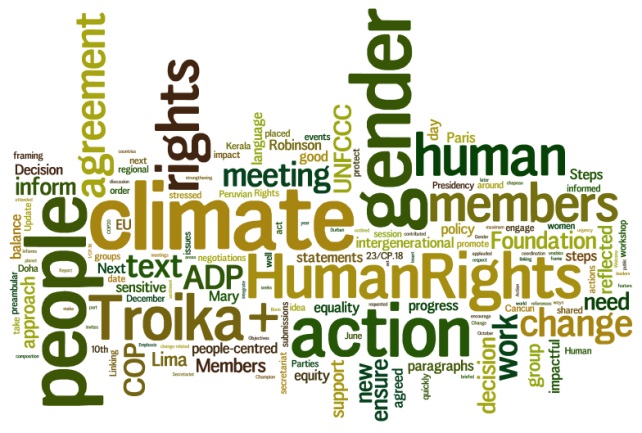
Women leaders gathering to discuss climate action that is good for people and the climate
JUNE 12 2014
During the Climate Change Intercessional in Bonn this June, Mary Robinson, President of the Mary Robinson Foundation – Climate Justice, invited members of the Troika+ of Women Leaders on Gender and Climate Change to discuss and promote a people-centred approach to climate action.
Participants included, among others, Troika+ members Christiana Figueres, Executive Secretary of the Climate Change Secretariat of the UNFCCC, Connie Hedgaard, the European Commissioner for Climate Action, the Dutch Minister for the Environment, Wilma Mansveld and a delegation from the South African Ambassador at Large for Climate Change who came together to exchange ideas and share experiences on the following two topics:
- How to further strengthen the participation of women and to promote gender sensitive climate policy
- How to Identify ways of strengthening the integration of human rights into the work of the UNFCCC process
“To make sure that climate action benefits all people as well as the climate, we need to guarantee that our climate action is fair and protects human rights. In order to achieve this we also need to give grassroots practitioners a platform to participate in dialogues with policy makers and to share the lessons learned from their experience.”
Aira Kerala, Senior Gender Adviser from Finland, was invited to brief the meeting on the progress on implementing the Decision 23/CP.18 that has placed gender on the agenda of the COP decision. She shared an update and the outcomes of a very well attended gender workshop at COP 19 in Warsaw and discussed plans for next steps at COP 20 in Lima with the Troika+ members.
During the discussion, Mary Robinson and the present women leaders highlighted the need for further work on gender participation and gender sensitive climate policy, referring to already achieved successes like the “Doha miracle” at COP 18 in Doha.
The participants of the Troika+ meeting also agreed the need for human rights to be an integral part of any future climate action, but especially to be enshrined in the text of the COP agreements at COP20 in Lima and COP21 in Paris, in order to ensure that the resulting climate action is having a positive effect for people as well as the climate.
The Foundation is currently working on a position paper on a people-centred framing for the 2015 agreement focusing on gender equality, human rights and intergenerational equity which will be published in due course.
Tuesday, June 3, 2014
When Surrender Means Not Giving Up: The New Sacred Activism

Carolyn Baker, Jun 3, 2014
Reposted from Shift Network Sustainability Showcase
There is nothing to do
And nowhere to go.
Accepting this,
We can do everything
And go everywhere.
~Mark Nepo~
A few weeks ago Andrew Harvey and I recorded a conversation between us on the topic of how to live in the face of catastrophic climate change. We made this recording in the context of other conversations about the need for a “new Sacred Activism” that is informed and updated by the dire realities of runaway climate change and near-term human extinction. [While the focus of this article is not on the science of climate change, the reader will find some of the most recent and ominous research on climate change below.*]
Recently, I’ve noticed some longtime activist voices verbalizing a new perspective and one that some would label as “defeatist.” Writing in his “How To Save The World Blog,” Dave Pollard recently offered a piece entitled “In Defense Of Inaction,” in which he states:
No one is in control. The enemy, if there is one, is not a cabal of elites, but a set of co-dependent collapsing systems that every one of us has a vested interest in trying (insanely) to perpetuate. Systems we have all helped co-create and are almost all dependent on…The question we must each ask ourselves, I think, is this: If we acknowledge that our systems and hence our civilization cannot be reformed or ‘saved’, what can we do now that will make a real difference, for the future, in our communities and for those we love?…The insanely rational answer to this question, I think, is (a) probably nothing, and (b) it’s too early to know.
Subsequently, Wen Stephenson’s “Let This Be The Last Earth Day,”in The Nation Magazine pleads:
End the dishonesty, the deception. Stop lying to yourselves, and to your children. Stop pretending that the crisis can be “solved,” that the planet can be “saved,” that business more-or-less as usual—what progressives and environmentalists have been doing for forty-odd years and more—is morally or intellectually tenable. Let go of the pretense that “environmentalism” as we know it—virtuous green consumerism, affluent low-carbon localism, head-in-the-sand conservationism, feel-good greenwashed capitalism—comes anywhere near the radical response our situation requires… The question is not whether we’re going to “stop” global warming, or “solve” the climate crisis; it is whether humanity will act quickly and decisively enough now to save civilization itself—in any form worth saving. Whether any kind of stable, humane and just future—any kind of just society—is still possible.
Isn’t this just giving up, or giving in? The pathetic whining of defeatists? How can any respectable activist utter these words?
I argue that, in fact, the perspectives articulated by Pollard and Stephenson are utterances of concession, but also of extraordinary courage. The word I choose to describe their perspective is surrender. But isn’t surrender synonymous with “giving up”? Aren’t Pollard and Stephenson really suggesting that we abandon the struggle, acquiesce, go back to business as usual, eat, drink, be merry, or possibly take our own lives?
What can we do?
In my recent article, “What Does It Mean To ‘Do Something’ About Climate Change?”I noted that, ‘Doing something’ implies that developed nations of the world and the fossil fuel industry will come together and:
1) Agree that climate change is actually happening;
2) Understand that the situation is so dire that humanity’s living arrangements must be radically altered;
3) Sacrifice their economic security and industrial profits to significantly reduce carbon emissions;
4) Agree to the reality of climate change and the altering of their living arrangements in time to prevent another 2 degree C rise in temperature.”
I then asked the reader what they genuinely, realistically thought can be done about catastrophic climate change, particularly in the face of more than 30 self-reinforcing feedback loops that are proving the process unstoppable and irreversible.
I believe that what both Pollard and Stephenson may be echoing is a third perspective that Andrew Harvey and I are naming “the New Sacred Activism.” That is to say that the fundamental issue is that we are being challenged to move beyond the triumphalist assumption that we can and must, through our activism, defeat capitalism, catastrophic climate change, economic corruption and collapse, and yes, the extinction of species, including our own. Indeed, our current predicament compels us to transcend the binary inference that if we do not conquer a diabolical system, we are only colluding with it and exhibiting shameful cowardice.
Contrary to our cherished assumption of vanquishing all forms of injustice, we must ask ourselves if we are willing to put love into action even if we don’t physically survive. The extremity of the crisis does not limit Sacred Activism, but rather expands it because we make ourselves available to 1) Bearing witness to the likely irreversible horrors of climate chaos and 2) Commitment to compassionate service to all living beings who suffer with us. This requires unwavering engagement with serving the earth community and practicing good manners toward all species in order to make their demise, and ours, easier. Taking one’s own life or succumbing to escapist self-medication is easy. Commitment to a life of service and fortifying one’s own connection with the sacred, thus deepening one’s sense of meaning and purpose, constitute a far more daunting and painful path.
Very often people who receive a terminal medical diagnosis report that while the announcement was heartbreaking, terrifying, and profoundly unfair, they experienced a certain kind of liberation in the process. Learning that they had only a limited time to live altered every aspect of their lives, particularly their quality of life, their decisions about how they wanted to engage with the remainder of their days, and their relationships with everyone and everything. Similarly, the reward of accepting the reality of near-term extinction is liberating even at the same time that it is agonizing. Something far more meaningful and momentous beyond our own physical survival becomes available to us.
The Hero Archetype
Human consciousness is deeply influenced by personal and cultural archetypes or universal themes of which we may or may not be aware. A few examples of archetypes are: mother, father, hero, savior, martyr, warrior, maiden, crone, healer, and many more. If we are not aware of the archetypes that influence us, we may unconsciously live them out in both creative and destructive ways.
Mythologist Joseph Campbell wrote and taught more about the hero archetype than perhaps anyone in modern times. Campbell simply defined the hero/heroine as “someone who has given his or her life to something bigger than oneself.” According to Campbell, the hero’s task is threefold: separation, initiation, and return. He/she usually experiences some sort of unusual circumstances at birth; sustains a traumatic wound; acquires a special weapon that only he/she can use; proves him/herself by way of some sort of quest or journey through which he/she is forever changed. The hero’s journey is one of death, rebirth, and transformation on which he/she embarks for the wellbeing of the community. Meanwhile, it is the hero, as well as the community who is transformed.
The pitfalls along the journey are many, but one of the most common – and also the most injurious to the hero and the community – is to become inflated with one’s heroic mission. One’s passionate commitment to the journey makes avoidance of this particular snare exceedingly difficult. Along the way, the hero may find him/herself becoming inflated but can always choose to pause, reflect upon the purpose of the journey and “something bigger” which compelled the hero to begin the journey in the first place. This is an opportunity to surrender to the ultimate purpose of the journey and the spiritual forces that motivated and support the hero. In all of mythology, the ultimate purpose is the transformation of consciousness, both one’s own and that of the community. In mythology, failure to surrender to the larger purpose of the journey guarantees the hero’s demise.
In Greek mythology the hero was always aware of the seduction of thinking himself equal to or wiser than the gods. Whenever heroes succumbed to this temptation, they began plummeting toward their demise. Perhaps the most famous example of the inflated hero is Icarus who, determined to soar, flew too close to the sun whereby his wings, which were made of wax, began melting, and he fell into the sea. Whether the wax wings of Icarus or the vulnerable heel of Achilles, the fundamental lesson with which all Greek mythological heroes were confronted was their human limitation and the consequences of forgetting those.
The hero symbolizes courage and sometimes appears as a warrior as well, but whether hero or warrior, courage is one of his/her stellar characteristics. One lesson the hero/warrior must learn is when to fight relentlessly and when to exercise restraint or surrender, for whatever reason, to the dilemma with which he/she is confronted. The Shambhala Warrior, for example, receives training in fighting spiritual rather than physical battles. Discernment regarding restraint or full-on combat is pivotal, and at all times the warrior must examine the heart and will. He/she does not continue fighting at all costs simply because “that is what warriors do.” Rather, the spiritual warrior considers whether or not it is time to stop fighting altogether or whether it may be time to change strategy. Fighting may not mean “winning” in the heroic sense, but rather, fighting for reasons that surpass even one’s survival.
As we confront catastrophic climate change which is likely to result in near-term human extinction, we must ask if we are willing to put love into action, even if we don’t survive. Can we move beyond a triumphalist agenda? Accepting the possibility of near-term extinction is an agony, but an agony that liberates the spiritual warrior in the powers of truth and love in order to discover the diamond hidden in the darkness that cannot be discovered in relentless fighting in order to “overcome.” The diamond can only be acquired by surrendering the need for anyone or anything to survive, even oneself. In the words of Andrew Harvey this is “a glorious and terrible adventure, but it is the antidote to despair.”
What we need now is not heroic victory but, again in Andrew’s words, an “astringent maturity,” an entirely new level of adulthood that acts in ways that bring forth optimum joy, optimum healing, and optimum beauty which will leave seeds for whatever life might remain as most species on the planet face their demise. The sacred inspiration we require results not from false hope or finding solutions, but from a state of active being in which we voluntarily enroll in radical psychological and spiritual training. If we haven’t registered for this psycho-spiritual apprenticeship, then we will persevere in our triumphalist agenda and inadvertently perpetuate despair.
Grief and the new Sacred Activism
Of paramount importance in the new Sacred Activism is regular, conscious grief work. Unless activists mourn, they can easily be consumed with the fires of passion because their psyches are not tempered with the waters of grief. Conscious grieving is an integral aspect of the “astringent maturity” we develop as we balance hero/warrior courage with discerning acceptance of our predicament. In his marvelous book Entering The Healing Ground: Grief, Ritual, And The Soul Of The World,Francis Weller states:
Grief is the work of mature men and women. It is our responsibility to be available to this emotion and offer it back to our struggling world. The gift of grief is the affirmation of life and of our intimacy with the world. It is risky to stay open and vulnerable in a culture increasingly dedicated to death, but without our willingness to stand witness through the power of our grief, we will not be able to stem the hemorrhaging of our communities, the senseless destruction of ecologies or the basic tyranny of monotonous existence…Grief is…a powerful form of soul activism. If we refuse or neglect the responsibility for drinking the tears of the world, her losses and deaths cease to be registered by the ones meant to be the receptors of that information. It is our job to feel the losses and mourn them. It is our job to openly grieve for the loss of wetlands, the destruction of forest systems, the decay of whale populations, the erosion of soil, and on and on. We know the litany of loss, but we have collectively neglected our emotional response to this emptying of our world. We need to see and participate in grief rituals in every part of this country.
Members of the Dagara Tribe of West Africa for hundreds of years have practiced regular grief rituals because they believe that both the earth and the community need periodic releases of grief. Without doing so, they say, the heart becomes and remains hard, and this becomes toxic for the community. Always a community versus a private ritual, the Dagara experience that grieving together solidifies the community and makes conflict resolution less problematic and complicated. As a result of the community grieving together, members of the tribe also experience something that Westerners might not expect, namely, a deepening of joy. In Entering The Healing Ground, Francis Weller shares his conversation with a Dagara woman immediately following a grief ritual. The woman displayed a radiant smile and seemed to exude joy from every pore. When he asked her how she could be so happy after engaging in a grief ritual, she replied, “I’m so happy because I cry all the time.” Her response, it seems, echoes the profound words of William Blake: “The deeper the sorrow, the greater the joy.”
Artist, educator, author, and activist Ann Amberg offers online classes in the powers of the universe and “how we can embrace a bio-spiritual, planetary species identity, inclusive of and embedded in the entire earth community.” Of our current catastrophic climate crisis she writes:
…we must be willing to mature and grow into our place of wholeness as a species in which we invite the earth and universe to inform our identity and to place constraints on our behavior. One evolutionary capacity might be learning to embrace “what time it is” –to partner with loss [my emphasis]–the acceptance that we are actually in an extinction phase and rapidly approaching the end point. To help us understand this destruction, we can recall what the cosmos does: the supernova that has been fusing for billions of years suddenly implodes. We don’t see it coming! It is hard for us to digest the deep ecological truth that the universe is our referent for what it means to be human, that technology will not save us….
Upon first reading Amberg’s statement, I was captivated by the phrase to partner with loss. Indeed, that is the crux of the new Sacred Activism. In partnering with loss, we open a door to unfathomable intimacy with the universe—a relationship that has the capacity to profoundly alter our very identity as consciously self-aware humans. It is one thing to struggle to save the earth, yet quite another matter to feel oneself inextricably connected with it in every cell of the body.
The Personal Perils of Heroic Activism
Recently, I have been personally shaken by the death of my longtime activist colleague and friend, Mike Ruppert. After decades of political struggle and physical health challenges, Mike took his own life on April 13, 2014. Literally thousands of people attribute their awakening to our planetary predicament to Mike’s efforts. The legacy he left for us is enormous, yet everyone close to Mike witnessed his reckless abuse of the body and the emotional wounding which ravaged his psyche and finally led to his suicide. As with many activists, Mike was only capable of surrender by terminating his physical life. While on the one hand, he had every right to choose that path, I believe that his demise is a cautionary tale against heroic activism.
Heroic activism, and particularly activism in which we do not grieve, invariably leads to burnout and compromised bodies and psyches. Rather than being self-indulgent, self-care, including grieving, is a spiritual practice that honors the corporeal container permeated by the sacred for the purpose of advancing its work.
Lean into the Anthropocene
At the website Welcome To The Anthropocene, this relatively new concept is explained:
Every living thing affects its surroundings. But humanity is now influencing every aspect of the Earth on a scale akin to the great forces of nature.
There are now so many of us, using so many resources, that we’re disrupting the grand cycles of biology, chemistry and geology by which elements like carbon and nitrogen circulate between land, sea and atmosphere. We’re changing the way water moves around the globe as never before. Almost all the planet’s ecosystems bear the marks of our presence.
Our species’ whole recorded history has taken place in the geological period called the Holocene – the brief interval stretching back 10,000 years. But our collective actions have brought us into uncharted territory. A growing number of scientists think we’ve entered a new geological epoch that needs a new name – the Anthropocene.
At the very least, humans are changing the chemistry of the planet. At worst, we are rendering it uninhabitable.
At first blush it may seem that the extraordinary quality of intimacy with the earth of which I have spoken would compel us to fight to our last breath to save it. When the heart is entwined with another living being, is not surrender to the demise of the beloved out of the question? Indeed, we stand in awe of earth warriors such as Julia Butterfly Hill, Edward Abbey, and Derrick Jensen who have devoted their lives to defending and protecting our planet. Yet as with a terminally ill beloved human, we must now realistically assess our capacity to spare our own species and thousands of others from near-term extinction. The heroic option of martyrdom for the Earth is indeed a viable one. So also is a conscious consent to admit ourselves to planetary hospice as Zhiwa Woodbury so beautifully and brilliantly articulates in his recent article “Planetary Hospice: Rebirthing Planet Earth.”
Woodbury, an environmental attorney and a practicing Buddhist states that “The Great Anthropocentric Extinction is upon us ….Sober consideration of the current, cascading evidence leads to the inescapable conclusion that life as we have come to know it is, quite simply, at an end.” At the conclusion of several pages of analysis of humanity’s unwillingness to meaningfully address and attempt to reverse climate change, Woodbury concludes that “Our situation is regrettably, terminal.”
On the one hand, the mental health profession should have a significant role in preparing us to face our demise, but it is ill-equipped to do so. Eco-psychology, however, “is reinventing psychology by including ‘the psychological processes that tie us to the world or separate us from it’ in a more holistic vision of the human psyche (Buzzell & Chalquist, 2009, p. 17) that views humans and the world we inhabit as inextricably bound together….So from an eco-psychological viewpoint, the question now becomes what is the role of mental health professionals in preparing society for the end of life as we know it?”
The hospice model can be applied with the perspective that the coming catastrophe does not have to result in widespread fear, panic, dread, or hostility. As I have noted in a number of articles such asPreparing For Near-Term Extinction; Fukushima And Catastrophic Climate Change: The Earth Community In Hospice, andHospice Is A Busy Place,12 many people in hospice report that it was the most meaningful time of their lives. For them it provided sacred space in which to reflect deeply upon their lives—to evaluate relationships that were enriching; to make amends and restitution with respect to some relationships that were difficult and painful; to provide service to others in their hospice environment; and to prepare mindfully and reverently for death.
In this regard, Woodbury concludes: “If we are able to apply the same principles at a societal scale, then ecopsychologists and planetary thanatologists can become the kinds of spiritual midwives that will be needed to transform the planetary death/rebirth process from a painful dislocation rife with suffering and regret into a healing process for both the human race and the Earth itself — even into a Great Awakening.”
Additionally, Woodbury applies Kubler-Ross’s Five Stages of Grief to The Great Dying/Great Awakening. In fact, the author reminds us, we are facing not only the possibility of near-term human extinction in the larger context of our planetary predicament, but also a plethora of endings on a smaller scale in terms of the limits of economic growth, energy depletion, and the end of life as we have known it in a variety of venues. Whatever our ultimate fate as a species, the fundamental assumption that progress is an infinite phenomenon to which humans are exceptionally entitled is unraveling at dizzying speed as human consumption is now literallyconsuming life on earth. Our spiritually puerile affirmations such as “Every day and in every way, everything is getting better and better,” must be supplanted, not by “Every day and in every way, everything is getting worse and worse,” but by a seasoned spiritual equanimity that wisely surrenders to whatever appears at the door of experience—a perspective so beautifully articulated by Rumi’s marvelous “Guest House” poem:
This being human is a guest house. Every morning a new arrival.
A joy, a depression, a meanness, some momentary awareness comes as an unexpected visitor.
Welcome and entertain them all! Even if they are a crowd of sorrows, who violently sweep your house empty of its furniture, still, treat each guest honorably. He may be clearing you out for some new delight.
The dark thought, the shame, the malice. meet them at the door laughing and invite them in.
Be grateful for whatever comes. because each has been sent as a guide from beyond.
The Great Dying cannot be practiced in isolation. Never before have humans required loving community to the extent that we do now. For as Woodbury notes, “… planetary hospice workers will be linked by a transmission of intention – the intention to be spiritual midwives for the rebirth of planet Earth. Just as the hospice movement today relies heavily on trained volunteers, so will planetary hospice rely heavily on the efforts of any and all who share the vision of the Great Dying as the dark night of collective humanity’s soul, and who are equally committed to ushering the human race through this difficult ‘night sea journey’ – during which ‘the sun sinks into the sea only to be devoured by the water monster – into the dawning light of a new day’.” (Washburn, The Ego and The Dynamic Ground,1995, p. 21).
Giving up, becoming defeatist? Is this the essence of the New Sacred Activism? Indeed it is not. Rather, as Woodbury notes, we must open to the “dark night of collective humanity’s soul” and live as if every act, every task performed in daily life, every kindness expressed to another being and to oneself might be the last. This is one way I stay connected with the light in dark times. Walking in reverence, living contemplatively with gratitude, generosity, compassion, service, and an open heart that is willing to be broken over and over again. I do not always live the way I want to live. It’s a practice, and practice never makes perfect. Practice only makes practice, and if I think it’s perfect, I’m not practicing. Nevertheless, I’d rather stumble in the dark, finding an occasional candle to light the way, than become blinded by incandescent heroism. And so in this time of unprecedented darkness, find the light whenever possible, but most importantly, be the light for someone else who may not be as familiar with the darkness as you are—and be willing to admit yourself to planetary hospice at the same time that you commit to being a hospice worker for the earth community. That may be why you came here, and that is the New Sacred Activism.
*The Science of Catastrophic Climate Change
Dr. Michael Mann, Pennsylvania State University, Climate Research Website
http://www.meteo.psu.edu/holocene/public_html/Mann/index.php
Skeptical Science: “Alarming New Study Makes Today’s Climate Change More Comparable To Earth’s Worst Mass Extinction”
http://www.skepticalscience.com/Lee-commentary-on-Burgess-et-al-PNAS-Permian-Dating.html
http://www.skepticalscience.com/Lee-commentary-on-Burgess-et-al-PNAS-Permian-Dating.html
Thom Hartmann Interviews Dr. Guy McPherson on Conversations With Great Minds, April 6, 2014
https://www.youtube.com/watch?v=G1GyIohx-tU
https://www.youtube.com/watch?v=G1GyIohx-tU
“Geo-Engineering Ineffective Against Climate Change”
http://www.livescience.com/43654-geoengineering-ineffective-against-climate- change.html
http://www.livescience.com/43654-geoengineering-ineffective-against-climate- change.html
Time Magazine, “Humanity’s Future Depends On Mission To Mars,”
http://time.com/76178/nasa-chief-humanitys-future-depends-on-mission-to-mars/
http://time.com/76178/nasa-chief-humanitys-future-depends-on-mission-to-mars/
Arctic News: “Arctic Methane Impact,” Sam Carana, November 28, 2013
http://arctic-news.blogspot.com/2013/11/arctic-methane-impact.html
http://arctic-news.blogspot.com/2013/11/arctic-methane-impact.html
Arctic News: “A Runaway Greenhouse Event,” John Davies, September 20, 2013 http://arctic-news.blogspot.co.nz/2013/09/a-runaway-greenhouse-event.html
Louise Leakey, TED Talk, “Is The Human Race In Danger Of Becoming Extinct Soon?” Huffington Post, July 5, 2013
http://www.huffingtonpost.com/louise-leakey/human-extinction_b_3543036.html
http://www.huffingtonpost.com/louise-leakey/human-extinction_b_3543036.html
Sunday, June 1, 2014
Antarctica Affected by Climate Change as Penguins Slowly Disappear

Antarctica Affected by Climate Change as Penguins Slowly Disappear
Ivelina Kunina, May 31, 2014
Rapidly changing climate has negatively affected one of Antarctica’s most favorite animals. The Adélie penguins, are slowly disappearing. Many scientists strongly believe that even small changes in penguin numbers can alert the world about Antarctica’s demise, bringing attention to the effects of rapid global warming and increased fishing. It is no secret that the world is interconnected, and it is not just one part of the globe that is affected by climate change. Deviation from the norm in any part of the world affects everyone, no matter where they might be.
The Antarctica New Zealand and Landcare Research began a penguin census project nearly 30 years ago. Based on penguin patterns and behaviors, scientists are able to better understand the ecosystem. In order to achieve optimal results, observation of the environment in which the indicator species reside is crucial. While penguins seem to be cute and fluffy animals, they play an important role in helping scientists explore and gain better understanding of how the ecosystem, and its changes, actually influence species.
Peter McCarthy is Antarctica New Zealand program support supervisor, and he is responsible for photographing the penguins. Once they are photographed, the photos are sent to the lab where the penguins are counted. Last summer, penguin population rose to 2.6 million birds, or 1.3 million pairs.
Although the population began increasing, rising sea levels, warmer temperatures, and melting ice resulted in less krill, which is a staple in the penguin diet. As temperatures get warmer, sea ice reduces, and studies have shown a correlation between the loss of krill and loss of sea ice. Sea ice being solid, acts both as a safe platform for the penguins and a krill creche. In a krill creche, baby krill develop into food for the penguins.
Scientists are excited about these new numbers, as they show improvement in the penguin population. Since the documentation of penguins began, Antarctica penguins have been slowly disappearing, and it was becoming clear that climate change had affected the birds. Over the past three decades, penguins averaged less than 900,000 breeding pairs. Much of the decline happened in the 1990s, however the penguins also faced tough challenges when a part of the world’s largest iceberg floated away and cut off a significant portion of their food source.
In addition, as the weather steadily warms, it results in more snowfall and melting snow in Antarctica. Snow and freezing water chill the penguins’ eggs, killing the embryo inside. While the changes in the weather may seem minor, they play a significant role in the life of a penguin.
While the Adélie penguins have boomed this year, their overall numbers are lower than scientists want. Although the penguin population did well, it is important to note that this is an anomaly and does not represent the overall changes in the penguin population throughout time. Combatting climate change at home is an important step in protecting animals and especially the slowly disappearing penguins in Antarctica.
The Antarctica New Zealand and Landcare Research began a penguin census project nearly 30 years ago. Based on penguin patterns and behaviors, scientists are able to better understand the ecosystem. In order to achieve optimal results, observation of the environment in which the indicator species reside is crucial. While penguins seem to be cute and fluffy animals, they play an important role in helping scientists explore and gain better understanding of how the ecosystem, and its changes, actually influence species.
Peter McCarthy is Antarctica New Zealand program support supervisor, and he is responsible for photographing the penguins. Once they are photographed, the photos are sent to the lab where the penguins are counted. Last summer, penguin population rose to 2.6 million birds, or 1.3 million pairs.
Although the population began increasing, rising sea levels, warmer temperatures, and melting ice resulted in less krill, which is a staple in the penguin diet. As temperatures get warmer, sea ice reduces, and studies have shown a correlation between the loss of krill and loss of sea ice. Sea ice being solid, acts both as a safe platform for the penguins and a krill creche. In a krill creche, baby krill develop into food for the penguins.
Scientists are excited about these new numbers, as they show improvement in the penguin population. Since the documentation of penguins began, Antarctica penguins have been slowly disappearing, and it was becoming clear that climate change had affected the birds. Over the past three decades, penguins averaged less than 900,000 breeding pairs. Much of the decline happened in the 1990s, however the penguins also faced tough challenges when a part of the world’s largest iceberg floated away and cut off a significant portion of their food source.
In addition, as the weather steadily warms, it results in more snowfall and melting snow in Antarctica. Snow and freezing water chill the penguins’ eggs, killing the embryo inside. While the changes in the weather may seem minor, they play a significant role in the life of a penguin.
While the Adélie penguins have boomed this year, their overall numbers are lower than scientists want. Although the penguin population did well, it is important to note that this is an anomaly and does not represent the overall changes in the penguin population throughout time. Combatting climate change at home is an important step in protecting animals and especially the slowly disappearing penguins in Antarctica.
Subscribe to:
Posts (Atom)